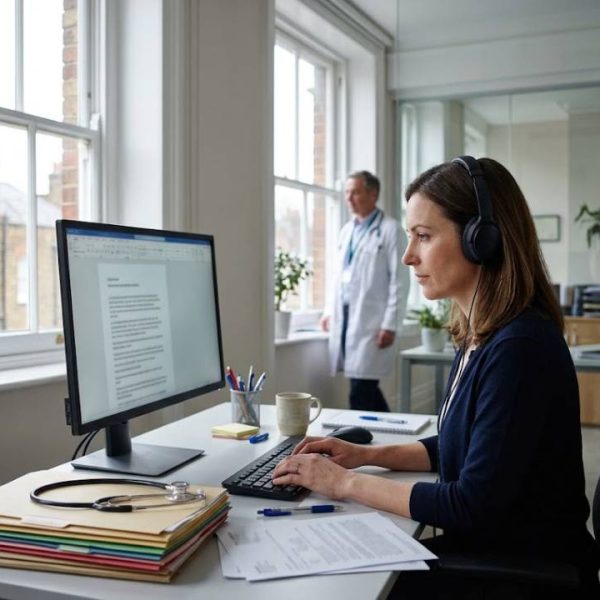
London's private clinics and hospital trusts see patients from every corner of the world. A consultant dictates a clinic letter after seeing a patient from Kuwait, a radiologist records a report for someone flying home to Romania, a surgeon prepares a discharge summary for a family returning to Brazil. Each of those recordings has to become an accurate written document, and often it has to exist in more than one language.
Transcription and translation are usually handled as separate tasks by separate suppliers. Treating them as one connected workflow reduces delays, cuts errors and protects patient safety.
Why transcription comes first
Medical transcription turns spoken dictation into structured clinical documents. It is a specialist skill: transcriptionists must recognise drug names, anatomical terms, abbreviations and the speech patterns of busy clinicians. The profession and its standards are outlined in this summary of medical transcription.
A translation can only be as good as its source. If the English transcript contains an error, such as "hypotension" heard as "hypertension", that error will be faithfully carried into every translated version. Accurate transcription is therefore the foundation of any multilingual record.
When patient documents need translating
International patients often need documents in their own language for very practical reasons:
- Their doctor at home needs to continue treatment and does not read English.
- Insurers or embassies require reports in a specific language before approving payment.
- Patients want to understand their diagnosis and medication instructions properly.
- Family members involved in care decisions need clear information.
Discharge summaries, operation notes, imaging reports, laboratory results and medication lists are among the most frequently requested documents.
When insurers, embassies or foreign authorities are involved, a standard translation may not suffice. Professional certified translation services attach a signed statement of accuracy that official bodies accept. Ordering certification together with the medical translation avoids delays in approvals and payments. It is the safest route whenever the receiving institution has formal requirements.
Precision with no room for guesswork
Medical language leaves little margin. A translated dosage must match the original exactly. Units must be preserved or converted with care. Abbreviations common in British practice may mean nothing to a clinician in Madrid or Riyadh, so they need to be expanded or explained.
Specialist medical translation services employ translators with clinical or life science backgrounds, often former nurses, pharmacists or doctors. They know that "stable" in an oncology report and "stable" in a cardiology note may carry different implications, and they ask questions when the source is ambiguous rather than guessing.
Confidentiality and data protection
Patient records are special category data under UK data protection law. Any provider handling them must offer secure transfer, restricted access and clear retention policies. Transcriptionists and translators should be bound by confidentiality agreements and trained in information governance.
Never send identifiable patient data through consumer translation apps or personal email. A single careless upload can become a reportable data breach. Ask suppliers where data is stored, who can access it and how long it is kept before deletion.
Building a joined up workflow
Clinics that handle many international patients benefit from a single pipeline. The consultant dictates; a medical transcriptionist produces the English letter; the clinician approves it; the approved version goes directly to a medical translator; the translation is reviewed by a second linguist; and both versions are filed in the patient record.
When one partner manages both stages, terminology stays consistent and turnaround improves. The translator can also query the transcriptionist about unclear passages, rather than sending questions back to a busy consultant.
Turnaround expectations
Patients travelling home after treatment often need documents within days. Agree service levels in advance: standard turnaround for routine letters, faster options for urgent discharge summaries, and clear arrangements for weekends. Predictable timelines help clinical and administrative teams plan, and they reassure patients that their records will be ready when they need them.
Quality checks that matter
Good providers combine human expertise with practical checks. Spell checkers loaded with medical dictionaries, number verification between source and target, terminology lists for each specialty and a second linguist review all help. For high risk documents, such as surgical consent forms or medication instructions, a clinical reviewer in the target language adds another layer of safety.
Interpreting at the bedside
Written records are only part of the picture. Many international patients also need an interpreter during consultations, pre-operative assessments and discharge briefings. When the same language provider supplies interpreters and translators, the vocabulary used in the consultation room matches the wording in the final letter. Patients hear and read the same explanations, which builds trust and reduces confusion.
Choosing a partner
When selecting a supplier, ask for evidence of medical specialisation, details of their data security arrangements and examples of turnaround times for different document types. Check whether they can work directly with your electronic patient record system or secure portals, and whether they offer audio transcription in languages other than English. Some patients dictate their own history in their native language, and that recording may also need transcribing and translating. A short pilot with a handful of real, anonymised documents is the best way to judge quality before signing a longer contract.
Serving patients well
International patients choose London for the quality of its care. That quality should extend to the paperwork they take home. Clear, accurate records in a language their own doctors understand support continuity of care and reduce the risk of misunderstandings once treatment continues abroad. Connecting transcription and translation into one careful process is a simple way to make that happen.